
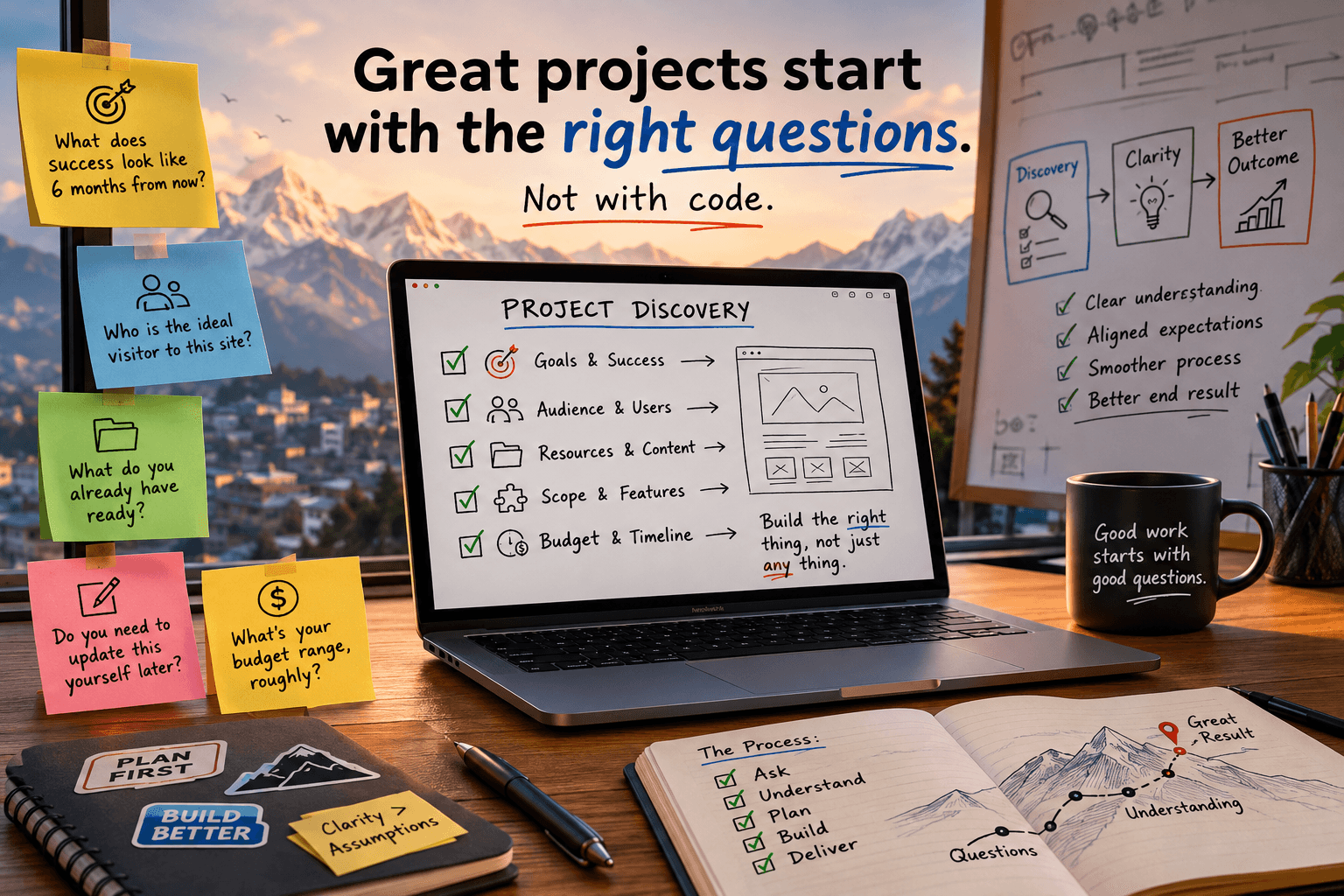
Early on, I used to start projects the way I think most new developers do - a client says roughly what they want, I get excited, and I open a code editor within the hour. It felt productive. It also meant I rebuilt entire sections more times than I'd like to admit, because I'd built the wrong thing confidently instead of the right thing carefully.
These days, nothing gets built until a handful of questions get answered first. Not because I enjoy paperwork - because every one of these questions has, at some point, saved a project from going sideways.
"What does success look like six months from now?"
This sounds like a soft, forgettable question. It isn't. Ask someone what they want their website to do, and you'll usually get a feature list - a portfolio section, a contact form, a blog. Ask what success looks like in six months, and you get something completely different: more inquiries from a specific kind of client, a promotion, landing a specific kind of opportunity.
Those two answers can point to very different websites. A feature list tells you what to build. The success question tells you why any of it matters, which changes what actually gets prioritized when time is limited - and time is always limited.
"Who is the ideal visitor to this site?"
Not "who's your target audience" in the vague marketing sense - genuinely, who is this one specific person, what do they already know, what are they nervous about, how technical are they. A portfolio built for a hiring manager skimming it in ninety seconds looks nothing like one built for a peer developer studying the code quality.
I've watched this answer single-handedly change a homepage's entire hierarchy. If the honest answer is "someone scrolling on their phone during a commute, deciding in ten seconds whether to keep reading," that's a completely different design brief than "a client's procurement team reviewing this alongside three competitors on a laptop."
"What do you already have ready?"
This one's unglamorous but it's the difference between a two-week project and a six-week one. Photos, bio text, logo files, testimonials - whether these already exist changes the entire timeline and asking upfront means nobody's surprised three weeks in when it turns out the "professional headshots" don't exist yet.
I ask this early specifically, so it doesn't become an awkward mid-project conversation. Nobody feels behind if the plan accounted for it from day one.
"Do you need to update this yourself later?"
This single answer decides whether a project needs a content management system built into it, or whether it can just be static and simpler. Building in editability nobody ends up using is wasted complexity. Not building it in when someone genuinely needs to update their own project list every month is a slow-motion support headache for both of us.
I've learned to never assume the answer. It's tempting to think "of course they'll want to edit it themselves" - some people genuinely don't want that responsibility and would rather just text me when something needs to change. Both answers are completely valid. Guessing wrong just costs time either direction.
"What's your budget range, roughly?"
I used to avoid asking this directly, worried it felt presumptuous. It's actually the opposite - a wide, honest range early on means I can recommend the right scope instead of either underselling what's possible or overbuilding something nobody asked for. A vague number is still more useful than silence, because silence usually means both sides quietly assume different things and find out much later that they were never aligned.
Why all of this happens before any design work
None of these questions are about being thorough for its own sake. They're about making sure the thing I eventually build is actually solving the problem someone has, not the problem I assumed they had after a five-minute conversation.
The best projects I've delivered all had one thing in common looking back - not better code, not flashier design, just a clearer, more honest conversation before either of us committed to anything. The projects I regret all skipped some version of this, usually because momentum felt more exciting than a slower, more deliberate start.
If you're evaluating a developer or designer for your own project, this is worth watching for directly: does the conversation start with questions about your goals, or does it start with a quote? The order tells you something real about how the rest of the project is likely to go.